

Cutting Basics
Feeds and Speeds
Before comparing routers and spindles, it’s important to understand how cutting works. When cutting material with a rotating bit, you can imagine that going too slow will dull or break the bit very quickly. For example, imagine trying to cut through a plank of wood with a saw, except instead of moving the saw back and forth you’re just trying to push it directly through. Similarly, a bit that’s moving too fast can burn or melt the material that you’re cutting. Finding a happy medium between these two extremes is a balancing act and depends on balancing three main factors:
- Feed rate / plunge rate – how fast the tool moves through the material
- Spindle speed – how fast the bit spins (RPM)
- Depth of cut & step over – how much material is removed per pass
These factors are called feeds and speeds. The feeds and speeds must be tailored to the specific cutting conditions, or else it could lead to broken bits, damaged material and/or uneven or rough surface finishes on your project. The cutting conditions that affect feeds and speeds include:
- Material hardness
- Cutting tool geometry
- Rigidity of the machine
- Geometry of the project
In order to balance speed, finish quality, and precision you must account for tool deflection and material hardness. When cutting, the tool can move away from where it should be, since it’s not able to cut the material fast enough. Harder materials require a more rigid machine and longer milling times to steadily cut the material away without this deflection.
Speed and Chip Size Relationship
Higher tool RPM produces smaller chips, while higher feed rates produce larger chips. Overall, if the chips are too large, your bit will be likely to break, but if your chips are too small (like fine powder), you will be dulling your bit.
This balance varies by material, bit size, and machine rigidity.
- Too slow = dull or broken bits
- Too fast = burning or melting
- Chips too large = broken bits
- Chips too fine = dull bits
Finding the sweet spot takes some trial and error, but it’s critical for both performance and tool life. Read more about Feeds & Speeds here.
Spindles vs Routers
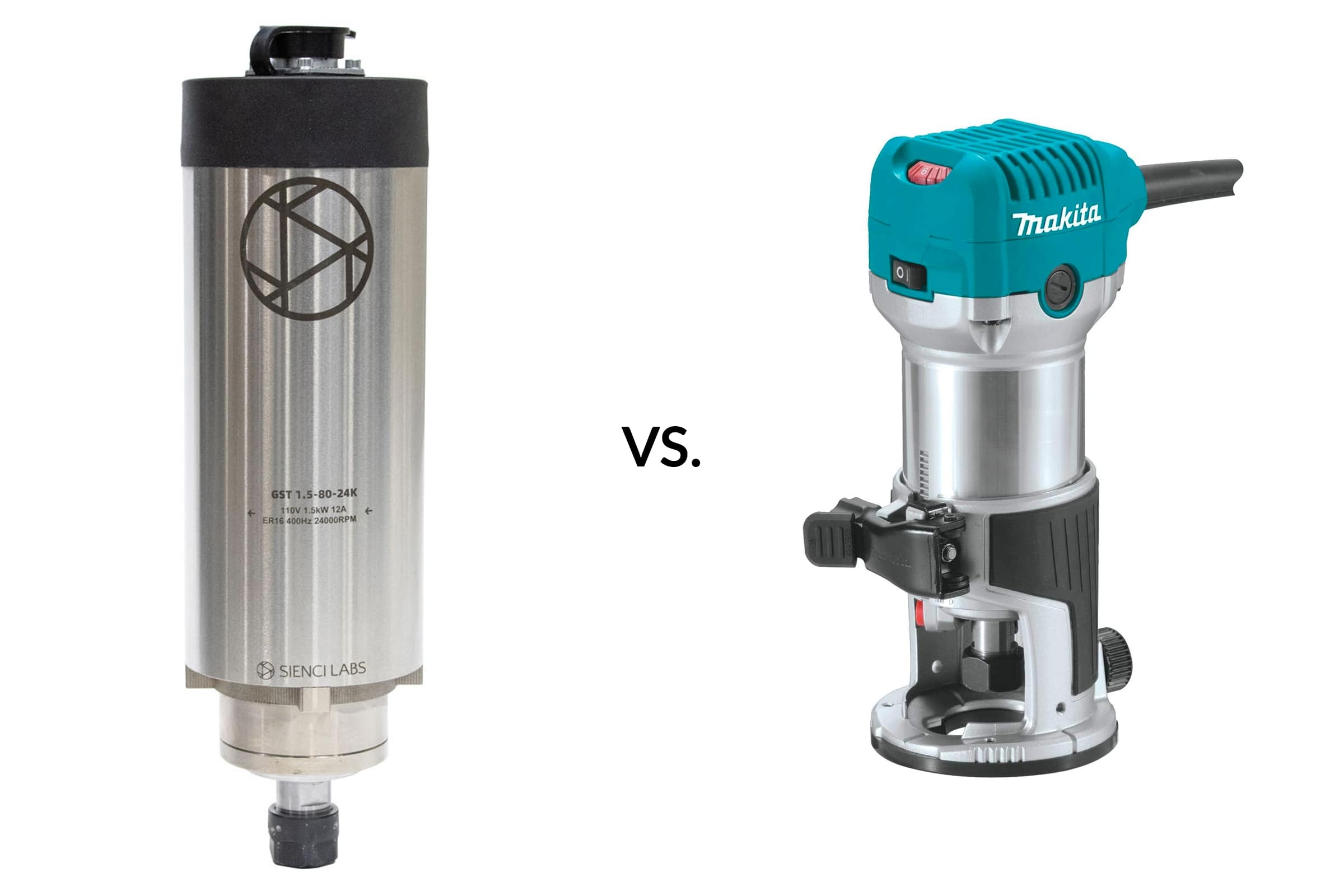
Both routers and spindles can be used on hobby to mid-level CNC machines. However, for most hobby CNCs (e.g. LongMill), a trim router strikes the best balance of cost, simplicity, and performance. As you get to higher-capability CNCs (e.g. AltMill), a spindle is worth considering especially if you value robustness, precision, and automation.
Major Differences
-
Spindles use a brushless motor whereas routers use a brushed motor. Therefore spindles generate much less noise than routers, and do not wear down any motor brushes that would require replacement.
-
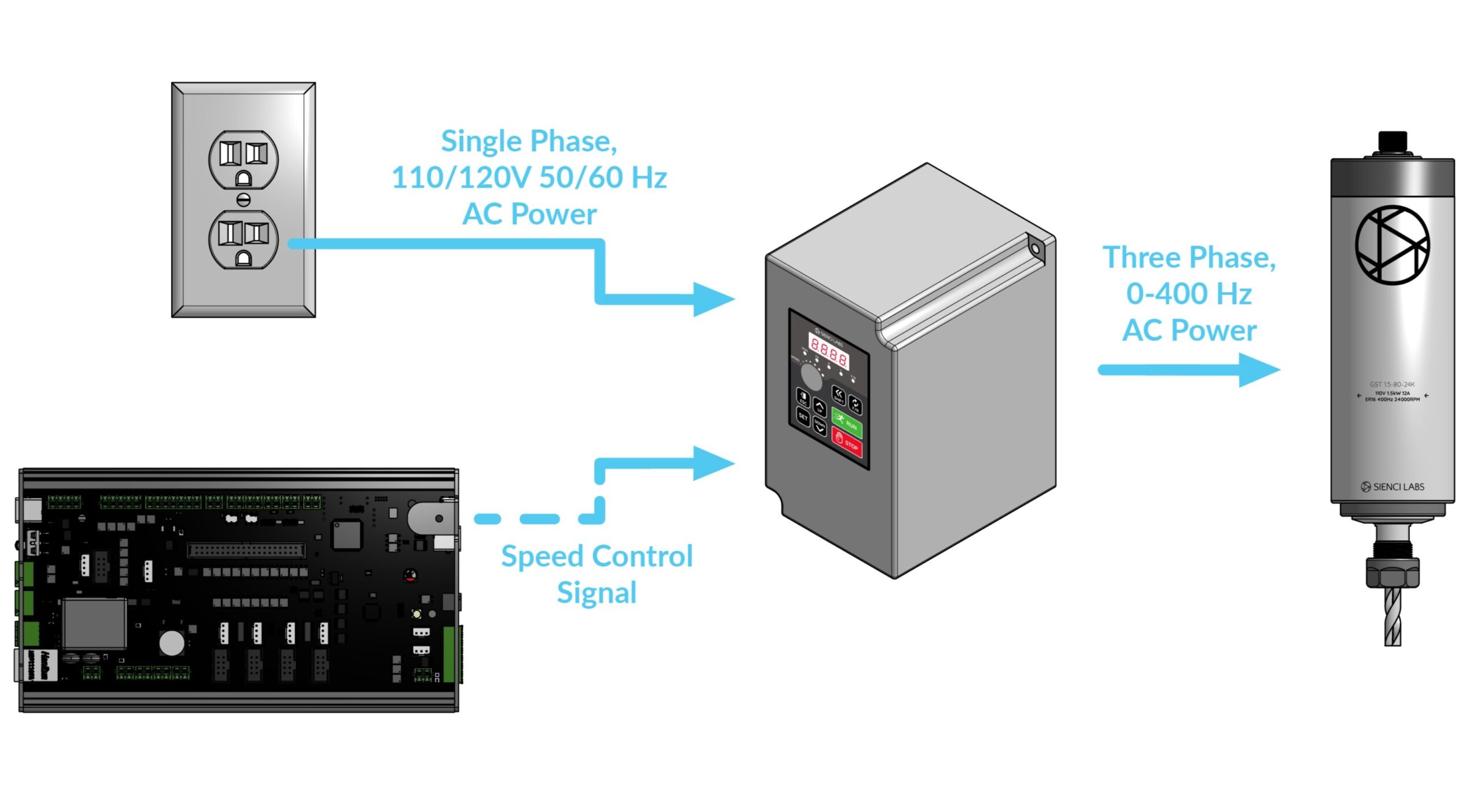
Spindles depend on an intermediate ‘VFD’ (variable frequency drive) unit to direct power from the wall outlet to the spindle motor, like shown in the diagram below. Whereas routers house all of its electronics inside of itself and plugs into a wall outlet directly.
-
Higher power spindles (greater than 1.5KW) will require 220V electrical wiring to run, whereas trim routers can run off 110V wall power.
-
Spindles are automated, meaning they can start, speed up/down, and stop through programmed commands from the controller via the VFD. Most routers are not automated, so users must manually set the router speed using a physical dial, and turn on/off the router at the start and end of a cutting program.
However, there are exceptions; custom routers like the AutoSpin T1 is capable of both manual speed control (with a dial) and automated speed control (like a spindle).
-
Spindles are designed to be more mechanically robust than trim routers, in order to withstand long cycles of cutting. However, routers still have plenty of power (~1.25HP) for cutting woods and plastics at several hours at a time.
Comparison Chart
| Feature | Router (e.g. Makita RT0701) | Spindle (with VFD) |
|---|---|---|
| Price | Low ($100–$150) | Higher ($300–$1000+) |
| Noise | Loud | Quiet |
| Control | Manual dial | Software controlled |
| Longevity | Brushes wear out | Long life |
| Setup | Plug-and-play | Requires wiring/VFD |
| Power | 1–1.25 HP | 1.5+ HP common |
| Precision | Higher runout | Lower runout |
Why Not Dremels or Handheld Rotary Tools?
Handheld tools like Dremels are not recommended. They are highly underpowered for use on most CNC machines, since they do not have internal hardware that allows them to support the high lateral and axial forces. In addition, these tools are fabricated for hand use, and as such aren’t designed for the minimal runout required to cut precisely.
Recommendations
- Beginners / Hobby CNC: Start with a router like the Makita RT0701 or AutoSpin T1. Affordable, easy, and reliable.
- Advanced users / Semi-production CNC: Upgrade to a spindle for quieter, more precise, and longer-lasting performance.
If you are a beginner user with a hobby CNC, we highly recommend sticking with a Makita RT0701. The Makita RT0701 offers plenty of power and speed control for this application. Installing a third-party spindle can be very technically challenging and may cost significantly more – we recommend checking our Forum and Facebook Group for more info.